
A cutter, a destroyer, and a maritime patrol aircraft are all extremely capable sensors. None of them is a persistent one. The difference is the whole problem.
Continuous maritime awareness is usually discussed as a sensing question, as though the limitation were detection range or discrimination. More often the limitation is simpler and harder: the asset that can see the area is not in the area most of the time, and putting it there costs something you would rather spend elsewhere.
Capability and presence are different quantities
An asset's usefulness for persistent coverage is not what it can detect. It is what fraction of the calendar it spends on station, and what it costs to hold that fraction.
That fraction is eroded by things that have nothing to do with sensing. Transit to and from the operating area. Crew rest and watch rotation. Scheduled maintenance and the unscheduled kind. Replenishment of fuel, stores, and consumables. Weather. Port periods. For aircraft, sortie duration and turnaround. For vessels, deployment cycles and the maintenance and training periods that bracket them.
None of these are inefficiencies to be optimized away. They are the cost of operating crewed platforms safely, and they are largely irreducible.
The arithmetic of staying on station
The consequence is structural. To keep one asset continuously on station, you need materially more than one asset committed to that station. How many depends on the platform, the distance, and the operating tempo, and anyone quoting you a universal ratio is selling something. But the direction is never in doubt: continuous coverage of a single area consumes a multiple of the assets that are visibly there.
Multiply that across several areas that all need watching and the demand compounds quickly. Fleets are sized against the full range of missions they are expected to perform, and persistent low-intensity monitoring competes directly with every other one of those missions for the same hulls and airframes.
The opportunity cost nobody budgets for
This is the part that tends to go unpriced. The work in question is frequently low intensity. Watching an approach. Maintaining a track picture. Noticing when a pattern changes. Being present so that absence is not the default condition.
That work matters enormously and almost none of it requires the specific capabilities that make a destroyer a destroyer. When a high-value crewed asset performs it, the asset is not being used for what it is uniquely able to do, and the crew is accruing hours and wear against a task that did not need them.
The cost shows up later and somewhere else: in maintenance backlogs, in readiness, in a crew that has spent its deployment on a task that could have been covered otherwise, and in the higher-priority tasking that went unaddressed.
What actually reduces the burden
Framed as a presence problem rather than a sensing problem, the useful question changes. Not how to see further, but how to be there continuously without committing a crewed asset to being there.
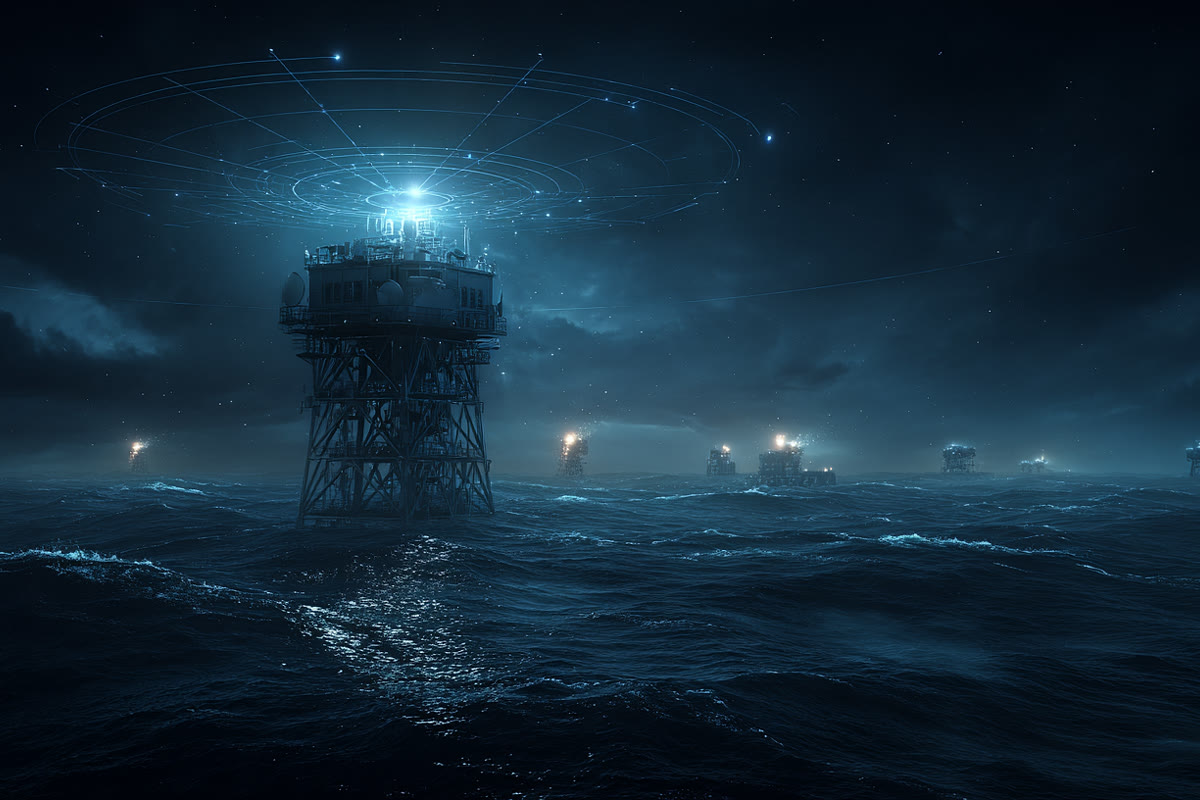
That points toward infrastructure that stays in place rather than deploying to a place. Something that does not need to transit, does not need crew rotation, and whose maintenance can be scheduled around rather than removing coverage entirely. Something that can host sensing, and that can also launch, recover, charge, and sustain the autonomous systems that extend reach beyond it, so that those systems are not themselves limited by how far they can get from shore-based support.
Hemisphere Aerospace Defense develops programs around that shape of problem. The Paul Revere Program, built around the AYDLL platform, is persistent maritime awareness infrastructure intended to carry continuous sensing, support autonomous systems operations, host modular mission capability, and connect to government reach-back command. It is in program development.
What it does not do
Persistent infrastructure is not a substitute for crewed cutters, destroyers, or aircraft, and it is not a ship or a weapons platform. It does not do what those assets do, and the argument for it is not that it replaces them.
The argument is narrower. If the continuous, low-intensity portion of the watch can be carried by infrastructure that was designed to stay in place, then crewed assets become available for the tasking that genuinely requires them. The objective is to free capability, not to substitute for it.
That arrangement raises its own question, and it is the right one to ask next: if infrastructure a contractor operates is carrying part of the watch, who retains command and response authority over what it sees?
If this describes a coverage problem you are working on, we would be interested in the specifics.
Discuss a program